There is no single Asian orchard tradition. Growers in the Mekong Delta face different water problems from those on upland slopes, while a family garden has different labour and harvest needs from an export orchard. Even within one district, drainage, planting material and market access can change the choices farmers make. Regional knowledge is most useful when treated as a set of informed responses rather than a timeless recipe.
The examples below introduce established patterns and the questions they raise. They do not describe every farm in each place. Practices continue to change with weather, disease, water availability and growers’ experience. For a planting decision, seek current local advice and ask people who manage productive trees under conditions close to your own.
Vietnam’s Mekong Delta: finding a workable root zone
In parts of the Mekong Delta, including fruit-growing areas of Ben Tre and Tien Giang, orchard layouts can include raised beds separated by channels. The point is not decorative geometry. Elevating the root zone and managing water can help accommodate low-lying land and a high water table. Channels may also be part of the farm’s wider water and access system.
Copying the appearance elsewhere can create new problems. Excavation may expose unsuitable subsoil, and drainage water needs a safe destination. Salinity intrusion, acid sulfate soils and seasonal water levels require local assessment. A modest raised planting area in a home garden is not equivalent to a managed delta orchard. First establish the water constraint; then choose a proportionate response.
Eastern Thailand: fruit production in a seasonal landscape
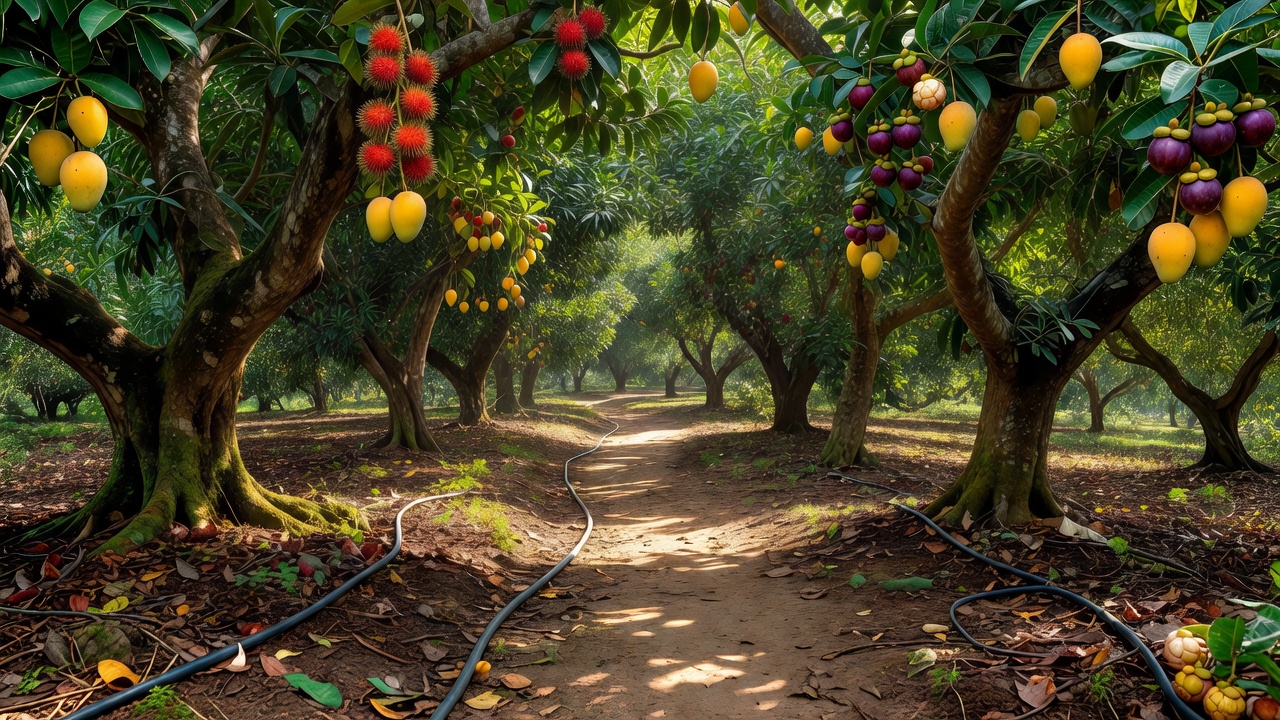
Chanthaburi and Rayong are associated with commercial fruit production, including durian, rambutan and mangosteen. A visitor may notice irrigation equipment, managed canopies and concentrated harvesting activity. These features make more sense when viewed alongside seasonal rainfall, crop value, labour and the need to maintain trees through less rainy periods.
The transferable lesson is to map the annual water balance and the crop’s growth stages. It is not to reproduce a commercial input schedule. An irrigation programme depends on soil, tree size, weather and equipment. In particular, imposing water stress to influence flowering can damage a young or already stressed tree. Such interventions require species-specific expertise and are not a beginner’s shortcut.
Southern China: cultivar and seasonal timing belong together
Guangdong and Fujian have long associations with lychee and longan cultivation. Named selections, flowering behaviour and local harvest windows matter because fruit development responds to weather as well as genetics. Moving a cultivar into a new district does not automatically move its familiar production calendar with it.
For a small grower, this suggests a practical research method: identify locally productive cultivars, ask how the trees were propagated and record the conditions around flowering. A regional cultivar name is useful evidence, but it is not a guarantee. Nursery identity, plant health and microclimate still need checking. Respect the expertise of growers without assuming one person’s successful technique applies to every site.
India’s west coast: diversity within a working landscape
In parts of Kerala, homegardens combine trees and other crops in layered arrangements. Coconut, jackfruit and smaller useful plants may share a managed space. In the Konkan region, mango production reflects another set of site and market relationships. Neither landscape can be reduced to the claim that mixing species always improves yields.
Layering can spread harvests, provide household products and make use of different canopy levels. It can also increase competition, shade and management complexity. When adapting the idea, select compatible mature sizes and maintain access to every tree. A familiar regional combination may rely on skilled pruning, particular spacing or a water supply that is not obvious in a photograph.
Compare the problem, not just the appearance
| Observed practice | Possible local purpose | Check at your site |
|---|---|---|
| Raised orchard beds | Keep roots above prolonged saturation | Soil profile, drainage outlet and water table |
| Mixed tree layers | Diversify products and use canopy space | Light, root competition and access |
| Managed dry-season irrigation | Support establishment and crop development | Water quality, supply and actual root-zone moisture |
Good adaptation begins with a small, observable trial rather than an orchard-wide conversion. Record the original problem, the change you make and the result across more than one weather event. Include costs and extra work, not only fruit yield. A practice that needs constant intervention may be unsuitable for your available time even when it works biologically.